

5,000 Hours of Touch, and Four Ways to Get It
Tactile is the modality everyone agreed was missing from robot pretraining at scale. 5 groups went after it in the past week, with similar methods but different answers on where the data comes from.
Four routes to tactile data
OpenNeoData is the largest of them. NeoteAI and Fudan released 200,000+ trajectories, more than 5,000 hours across six embodiments, with two gel visuotactile cameras on every gripper time-aligned to RGB at 30fps for the entire dataset, in LeRobot v3.0 format. They shipped two models trained on it, N₀-VTLA, which they describe as the first VLA pretrained on tactile data at scale, and N₀-TWAM, a world-action model that predicts future contact alongside future vision. Being-H0.8 avoids the sensor cost at pretraining time, using a model called TactoHand to infer dense contact and proximity fields from over 500,000 hours of ordinary egocentric human video, then using measured pressure from instrumented hands where it has it. ViTacWorld leans on simulation, and makes the interesting argument that tactile signal may cross the sim-to-real gap better than vision does, because contact is grounded in physics rather than appearance. τ is the cheapest, learning a tactile representation from future visual supervision in latent space during training only, so it adds nothing at inference. FeelWorld predicts contact, force and slip as separate states, gating them so free-space motion does not degrade the visual prediction.
What is striking is how much they agree on once the data is in hand. Four of the five train on predicting future tactile state. N₀-TWAM predicts future vision and contact together, ViTacWorld predicts both from an action sequence, FeelWorld predicts visual latents alongside contact, force and slip, and Being-H0.8 learns from future visual and tactile evidence. The representations differ underneath, N₀-TWAM using a force-based encoding and Being-H0.8 contact fields over a hand mesh, but the objective has the same shape. The disagreement sits upstream of the model, over what an hour of contact data should cost.
Which leaves the question nobody has answered. Being-H0.8’s pseudo-labels cost almost nothing per hour and cover a corpus a hundred times larger than OpenNeoData’s, while OpenNeoData’s are real measurements from real sensors. Only one side of that comparison is downloadable. OpenNeoData is up, gated behind a contact form; UniHand 3.0 is not, and neither are Being-H0.8’s weights.
Research
FLUX 3 drives robots on Audi’s floor
Black Forest Labs released FLUX 3, a multimodal model trained on tens of millions of hours of video, and gave mimic robotics early access to build FLUX-mimic. A compact action decoder reads intermediate features from the video-prediction path and denoises action chunks straight out of them, so no video is rendered at inference and a chunk costs one forward pass. On a soft-body kitting task on real hardware they report 95% success with no task-specific fine-tuning, against 55% for an adapted π0.5 trained on the same data mix, and full-system reaction time of 101ms on an RTX 5090. The numbers are mimic’s own on their own tasks, FLUX 3 is early access, and the open-weight backbone is promised rather than out.
HiFi-UMI removes the real-robot anchor
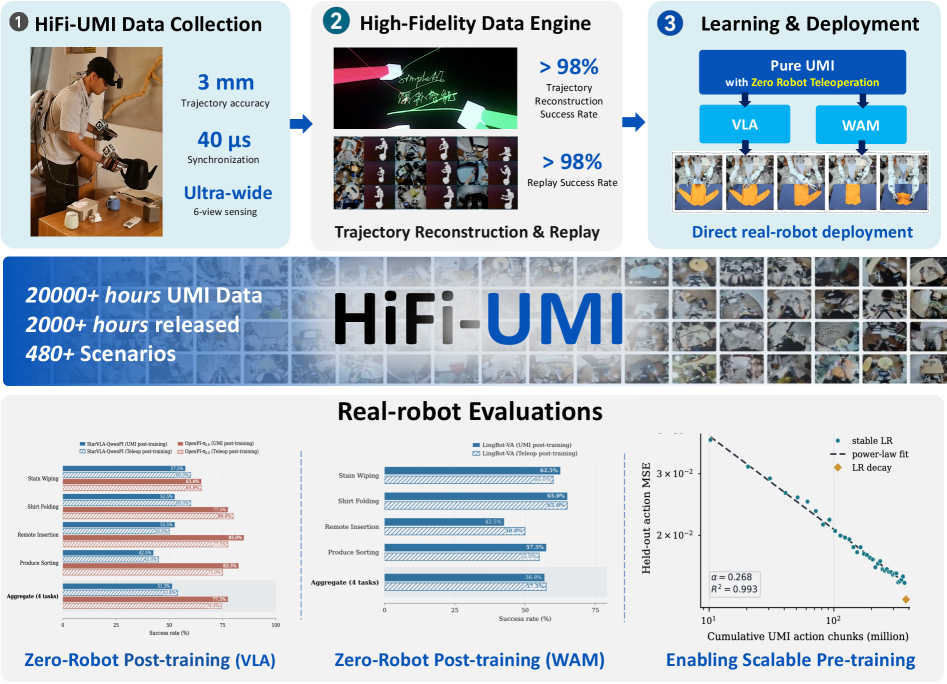
The usual recipe is to scale with robot-free data and then anchor with a little real-robot teleoperation. HiFi-UMI asks whether the anchor is a consequence of low-fidelity capture, and builds a rig for 3mm end-effector accuracy with under 40µs cross-sensor sync and roughly 200° of coverage per gripper. A policy post-trained only on their data deploys directly and matches in-domain teleoperation on three separate backbones, within 3.1 percentage points on both VLAs tested. They released HiFi-UMI-2K, a 2,000-hour curated slice of a 20,000-hour corpus, with every episode replayed in simulation and quality-checked.
πR² makes flow policies react mid-chunk
Action-chunking flow policies run open-loop inside a chunk, so they cannot respond to anything that arrives mid-execution, and the backbone is too slow to simply replan more often. πR², from CMU, splits conditioning into a fast proprioception channel refreshed every tick and a slow vision-language channel updated asynchronously, then emits actions in one denoising step per call. Applied to GR00T-N1.7 on a real xArm6, it replans roughly 4x faster than the base policy at 25Hz, acting on a fresh observation every 40ms, and improves real-world success by up to 30%. It finetunes from an existing checkpoint with minimal architectural change, and one trained model adapts to whatever hardware latency you have.
A scaling law for precision, and a way to move it
The Curse of Precision, from Tsinghua, measures how demonstration count relates to achievable precision in closed-world tasks like assembly, and finds demos grow super-exponentially as target precision approaches a limit, following log(N) ∝ 1/(P−c). The useful part is that the limit c turns out to be a property of the whole system rather than the task, so adding a wrist camera or improving the expert measurably lowers it. If a high-precision policy has stalled, the law tells you whether to collect more data or change the hardware.
AXIS collects manipulation data through a browser
AXIS argues the data bottleneck is an infrastructure problem more than a hardware one, and runs teleoperation in a browser so contributors need no rig or local simulator. Community demonstrations pass through automated success checking, quality filtering, trajectory smoothing, and physics-based augmentation before entering training. Continual pretraining on its 207 tasks and 50,000+ trajectories lifts π0.5 by 5.8% overall, with the biggest gains under layout changes, sensor noise, and camera perturbation.
ArmnetBench evaluates policies on a farm of cheap arms
Real-world evaluation is expensive because every rollout needs hardware and an operator, which is why most papers report a few dozen trials on one robot. ArmnetBench runs a managed fleet of low-cost SO-101 cells in parallel and compares 7 policies across 12 tasks on a shared 50-demo budget, releasing all 3,118 episodes with three-way quality labels in LeRobot v3.0. It is also unusually candid about what it measures, stating plainly that a shared-budget leaderboard does not estimate any method’s ceiling, and naming the unreported choices that inflate success rates elsewhere.
WorldDiT gets to the LIBERO frontier without a VLM
WorldDiT, from Bagel, couples continuous action generation with future RGB patch prediction in a single diffusion transformer and deliberately leaves out a large pretrained VLM backbone. At 399M total parameters it reports 94.9% mean success across the four LIBERO suites, on the reported parameter-versus-success frontier, with four checkpoints and a full inference runtime released. It is worth reading for the honesty as much as the result, since the paper states outright that 300 of its 500 episodes per suite informed checkpoint selection and the headline number is therefore not an unbiased test estimate.
The field outran its own survey by a day
Data Pyramid for Embodied Manipulation is an eleven-institution map of the embodied data ecosystem, sorting five sources by the tension between scalability and robot alignment and then reading recent foundation models back through their data recipes. Its first named open challenge is building large-scale tactile datasets, which OpenNeoData had shipped the previous day. The six challenges make a decent research agenda even so.
HOST learns a skill in 29 seconds from one human video
HOST predicts the robot’s progress through a demonstrated task, translates the next step into the robot’s own future observations, and derives actions from those. It acquires a new skill at inference time from a single human video in 29 seconds on average at 62% success, beating a baseline finetuned on 50 robot demonstrations per task, and it does so without eroding skills already learned.
MiniCPM-Robot is a 1.5B VLA under Apache-2.0
Worth catching if you missed it earlier this month. OpenBMB open-sourced MiniCPM-RobotManip, a 1.5B generalist manipulation VLA, alongside a 0.9B tracking model and an inference framework, all under Apache-2.0 with code on GitHub. They report it beating π0.5 (3B) and Qwen-VLA (5B+) on representative evaluations, with 120ms forward latency on an H100 against 234ms for π0.5, and streaming inference that folds 60 frames of history into context for 3.3 TFLOPs per step instead of 125.
Worth reading
Chris Paxton on how much robot deployment data is actually worth, arguing that deployed robots rarely encounter enough novelty to matter, that constrained industrial tasks generate little transferable knowledge, and that useful collection needs either environments with inherent variety or teams manufacturing novelty deliberately. It sits in productive tension with most of the items above.
Quick hits
TableVerse-100K — ByteDance reconstructs 100,000 physics-ready tabletop scenes deterministically from in-the-wild internet images instead of hallucinating layouts from text, with 4TB on the Hub and a frank note about long-tail artifacts.
When Does Legacy Data Start to Help? — co-training on demos from your previous hardware generation does nothing until the new configuration crosses a competence threshold, then jumps sharply (23.3% to 86.7% on one task).
Scale Up Strategically — Northeastern and NVIDIA find VLAs ground language unevenly, in a consistent order of color, object, spatial, verb, size, and reallocating collection budget toward the weak factors wins with half the demonstrations.
KineBench — evaluates embodied world models without an inverse dynamics model, extracting 6D poses directly from generated frames to remove the ambiguity between model error and extractor error.
Robot-Factored World Models — render the robot through its URDF so the world model only ever sees the action as visible geometry, which generalizes to unseen embodiments.
Pictura — valeo.ai renders every agent’s egocentric view at 500,000 agent-steps/s on one H100, and trains the first large-scale driving self-play policy directly from perspective images.
Emergent Compositional Skills in MoE VLAs — experts in a mixture-of-experts action head specialize into reusable low-level behaviors with no hierarchy specified in advance.
GS-Agent — UMass and Genesis AI generate 4D physical worlds from language with a physics engine in the loop and agents iterating against multimodal feedback.
Industry
Generalist measures which hand teaches its model most
GEN-1 now runs across roughly 9,000 end-effector variations spanning five-finger hands, whisks, peelers, tongs, and power screwdrivers, out of an in-house corpus of over half a million hours. The transferable idea is the measurement, comparing the pretrained model to the same model finetuned on a new tool and treating the weight difference as a task vector, decomposed across sensing, reasoning, and actuation. Whisks shift the sensor-processing weights far more than peelers do, which tells them to go collect more thin, visually sparse tools.
Jetson prices are up as much as 101%
NVIDIA raised Jetson module and devkit prices by up to 101%, which lands awkwardly against the Jetson Thor push toward on-device inference. Worth checking before you plan a fleet’s compute budget.
Worth Watching
Xiaomi-Robotics-1 promised code and weights on July 16 and the repository is still a placeholder with no license, two weeks on. Being-H0.7’s checkpoints have been coming soon since April, and Being-H0.8 shipped this week with no weights either.
The N₀ checkpoints are the ones to watch. OpenNeoData is live, so if the models land the whole tactile stack becomes reproducible.
Black Forest Labs says an open-weight FLUX 3 backbone is planned. That would let anyone test whether the video-pretraining result transfers outside mimic’s setup.
IROS 2026 is in Pittsburgh, September 27 to October 1, and project pages are landing now.