

You can reproduce the whole robot now
LeRobot Humanoid is an open-source, ~$2,500, 3D-printed biped. More interestingly, it ships as a full stack: BOM and CAD, a unified sim/real runtime, MJLab training environments, and sim-to-real identification tools that fit simulator parameters from replayed data. This significantly reduces the barrier to entry for working on humanoid robotics.
The LeRobot dataset hub crossed 58,000 datasets the same week, up from ~1,145 at the end of 2024, and is now the largest single category on the Hugging Face Hub. The post also noted some known issues: wide sim/real quality variance, thin locomotion coverage, and a deployment-relevant CVE (CVE-2026-25874) worth checking before you ship.
Research
A loud week for VLAs
π₀-EqM swaps π₀’s flow-matching action decoder for an energy-based “Equilibrium Matching” one, taking RoboTwin from 40.4 to 50.2 at matched compute. A decoder-level change to a model many teams already run.
EXPO-FT — sample-efficient RL fine-tuning recipe; 30/30 on every evaluated real-robot task within about 19 minutes of robot data on average.
TapSampling — training-free inference-time method: sample candidate actions from an Action-VAE, pick with a task-progress verifier, bolt onto an existing policy.
X-DiffVLA — cross-embodiment diffusion action head; +15.3 / +12.5 on RoboCasa / Isaac Gym, plus real-world validation.
SOMA — persistent spatial memory, so a VLA can act on targets that have left the camera view.
“Understanding the Impact of Geometric Foundation Models on VLAs“ — linear-probing study quantifying the “geometric gap” in VLAs and comparing three architectures for injecting 3D understanding.
Where the demonstrations come from
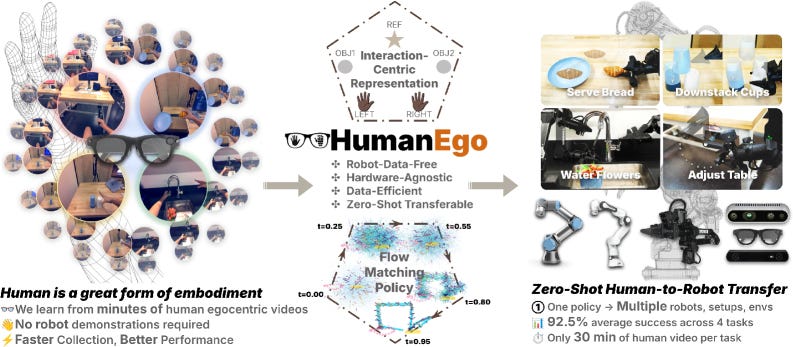
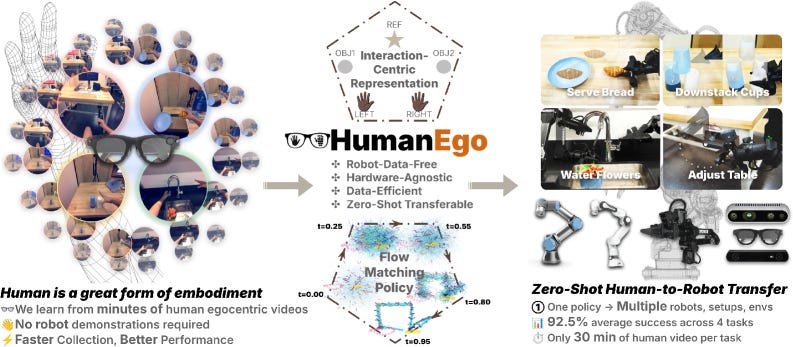
HumanEgo learns from human egocentric video: about 30 minutes of footage per task, hand-object interaction at the entity level, and a flow-matching policy that hits 92.5% on real tasks and transfers zero-shot across different robots and scenes.
HumanoidMimicGen — MimicGen pushed to whole-body humanoids (NVIDIA GEAR + UT Austin): take a few source demos, adapt them into many collision-free whole-body trajectories combining locomotion with one- and two-arm manipulation, co-train on the synthetic pile plus a little real data. Evaluated on a sim benchmark; no headline success number.
FineVLA re-annotates existing data: 47k human-verified fine-grained labels across 972k unified trajectories (10 datasets), plus an annotation tool and benchmark, all open. Mixing fine + coarse instructions lifts success up to +8.1 points and makes policies steerable (pose +23, color +18); 62.7 vs 49.9 baseline on real dual-arm.
Also notable
HyperSim — end-to-end sim-to-real pipeline (high-fidelity synthesis + adversarial trajectories + sim/real co-training); 80–95% success on real manipulation.
Imagine2Real — video generative priors for zero-shot humanoid-object interaction; represents robot and object motion as unified 4D point trajectories and tracks sparse keypoints to skip explicit retargeting.
“Can VLA Models Learn from Real-World Data Continually Without Forgetting?“ — answer: no, not by default. Documents catastrophic forgetting on streaming real-world data and tests experience replay as a fix.
PhysX-Omni — simulation-ready 3D asset generation (rigid, deformable, articulated) with physical attributes like scale, material, and kinematics. More graphics than robotics, but sim asset creation is a real chokepoint.
Industry
Reachy Mini goes fully local
Hugging Face shipped a fully on-device conversation stack for Reachy Mini: VAD → STT → LLM → TTS, with llama.cpp / MLX / vLLM backends and no cloud or API keys. On-robot voice without a server round-trip means lower latency, and your kitchen audio stays off someone else’s API.
Stord Labs
Stord raised a $250M Series F and stood up Stord Labs for robotics and physical AI, planning to train on operational fulfillment data across roughly 100 facilities rather than sim alone.
Worth Watching
Robotics Summit & Expo — May 27–28, Boston.
MolmoAct 2 (Ai2) — open weights and code, plus what they call the largest open bimanual manipulation dataset at 720+ hours.
ESI-Bench (Fei-Fei Li’s group) — benchmark for whether a model can decide what to go look at in a 3D scene instead of just reading a static image; documents “action blindness” in frontier models.
See you next week.