

A Million Hours of Human Video, Zero Robot Frames
Dyna Robotics claims it trained a robot policy using a million hours of first-person human video, without any robot data.
Dyna’s scaling law and what you can verify
Dyna trained one model at 1K, 10K, 100K, and 1M hours of human video and measured what each budget bought. Before any robot data went in, they tested it on 39 manipulation tasks across two bimanual YAM platforms. Every score improved as the pretraining video grew. On a separate set of 14 tasks, this time with robot post-training, the aggregate score climbs 20%, 28%, 45%, 53% up the same ladder. The result people will quote is Lockbox Key Turning, which sits at 0% at every budget through 100K hours and reaches 90% at a million.
DYNA-2 is a world-action model. It uses a video-diffusion backbone and a mixture of transformers. The model denoises future video and future actions, either together or separately. The pretraining set is over a million hours of human video. It shows people cooking, tidying, folding, and assembling. The footage comes from Dyna’s data partners and its own operation. Annotation combines 3D hand-pose tracking with pseudo-action labels. Those labels come from wrist poses and grasp signals. No robot frames go in at any point.
Two things to keep straight. Most coverage ran “20% to 80-90%” as the scaling headline. That figure belongs to one manufacturing task, and the 14-task aggregate tops out at 53%. Reporting also settled on “13 minutes” of fine-tuning data for the two-hand bottle-cap task, where the report says roughly 10.
There are no weights, no code, no dataset, and no arXiv posting. The technical report is on Dyna’s own site. Dyna designed, ran, and scored the 39 held-out tasks and the 14 post-training benchmarks. It also chose the evaluators for the comparison against DYNA-1. One piece of external grounding does exist. 27 of the 39 evaluation tasks come from the public xdof ABC dataset rather than being built in-house. That makes a partial outside replication possible. If the curve holds up in someone else’s hands, that is a bigger story than the launch was.
Research
The same checkpoint scores 84% or 8%, depending on how you ask
LeWorldModel is a JEPA world model from a team that includes Yann LeCun. It gets cited as evidence that latent world models are ready to plan with. An independent reimplementation rebuilt it for about $25 and matched the published TwoRoom number. Then it found the number is not what it appears to be. Four training conventions decide whether the model converges, and none of them appear in a released config file. Anyone following the published configs gets a predictor that never trains. Worse, the released material disagrees with itself about how to evaluate. The paper’s appendix and the repository config specify different goal offsets and step budgets. On the authors’ own checkpoint, those two protocols score 14% and 84%. Change nothing but how the goal is constructed, and the same checkpoint drops to 8% across fifty identical episodes. Every one of those numbers describes the same weights. None of this makes LeWorldModel a bad model. It does mean a published planning score reflects the evaluation protocol as much as the weights. Comparing two checkpoints means running both yourself, under one protocol you control.
GAUGE measures physics engines against reality, and none of them win
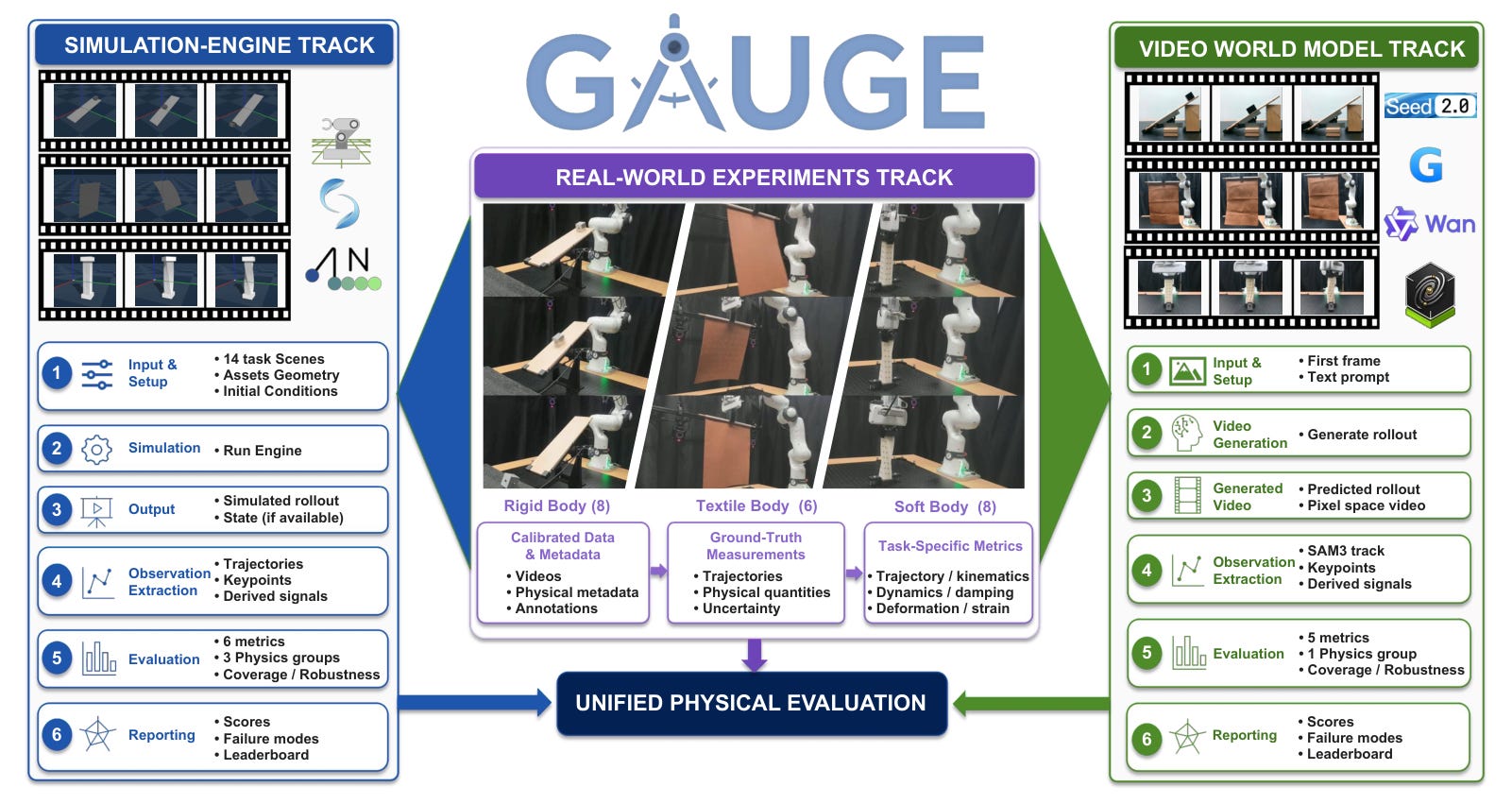
GAUGE evaluates Isaac Sim, Genesis, and Newton across 14 task families. It scores them against real measured trajectories, with calibrated physical metadata and uncertainty annotations. Coverage spans rigid bodies, flexible cables, textiles and volumetric deformables. No engine is faithful across all of them. The largest errors cluster in impulsive contact, fast textile motion, and volumetric deformation. On the generative side, six image-to-video models can produce trajectories that match the expected equation form. The same trajectories still get accelerations, momentum transfer, and oscillation timing wrong. The practical read is that engine choice is task-dependent. If your tasks involve impulsive contact or cloth, the engine you standardized on may be the wrong one for them.
RynnValue derives reward labels from timestamps
Reward models are the expensive part of RL post-training, because someone has to sit and label preferences. RynnValue uses a label you can read off a timestamp. Every frame is tagged with how much time is left before the instructed task finishes. The authors call this temporal distance. Nobody ranks anything by hand. That scales to over 7,000 hours and roughly 3M instruction-conditioned clips, with no preference or progress annotation at all. Three tricks stop the model from gaming the label. The useful one is shuffling the temporal order during training, which forces predictions to stay sensitive to failures and regressions. It reports a Kendall’s tau_a of 0.675 on RBM-EVAL-OOD, against 0.655 for the preference-supervised state of the art. Real-world policy success rises from 52.5% to 72.5% online. Weights are Apache-2.0.
JD reports no ceiling either, over a much shorter range
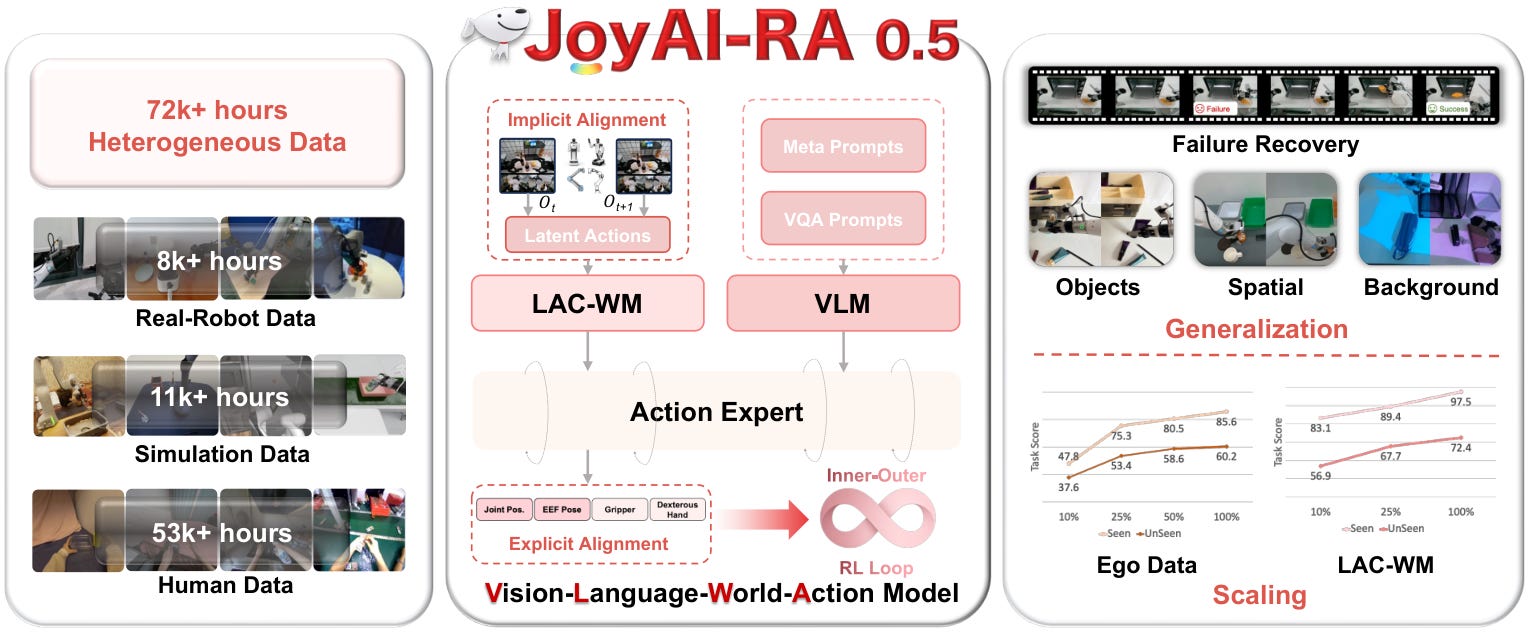
JoyAI-RA 0.5, from JD’s Joy Future Academy, reports the same absence of saturation. Task score on a real-world AgiBot G1 benchmark rises with human egocentric pretraining volume and does not flatten at full scale. Read the two claims side by side, because they are not the same size. Dyna sweeps absolute hours from 1K to 1M. JD sweeps fractions of its own corpus at 10%, 25%, 50%, and 100%, so roughly 5,300 to 53,000 hours. Four orders of magnitude against one. JD combines over 53,000 hours of human video with more than 8,000 hours of real-robot demonstrations, across bimanual and single-arm embodiments. Two alignment paths hold those sources together. One infers latent actions from visual transitions, which lets action-free data train a world model conditioned on those actions. The other maps human and robot trajectories into a shared canonical action space. Both results are self-reported, and neither lab has released weights. Two groups reaching the same conclusion independently is still harder to dismiss than one. If the curve holds, the budget question shifts from how much robot data you can collect to how much human video you can get labeled.
Flex-π finds 3D supervision hiding in a frozen VAE
Most world-action models predict RGB latents trained for pixel reconstruction. Nothing in that objective tells them about 3D geometry, which manipulation depends on. Flex-π reports that the same frozen video-generation VAE that encodes RGB also encodes 3D point maps almost losslessly. It needs no pointmap-specific training to do it. That gives this 6B model supervision on geometry and object-centric DINO semantics alongside RGB. It costs nothing extra in sensors, pretraining, or latency. Per-stream dropout with cross-modality forcing lets one checkpoint run on any subset of streams, from action-only to full joint generation. Reported gains reach 2-7x over the strongest baselines on real bimanual dexterous tasks, in and out of distribution, while running faster than π0.5. No weights yet. Whether your own video VAE encodes pointmaps the same way is a one-afternoon check.
LeRobot adds parallel training and native support for four outside VLAs
Parallel training landed, with FSDP2 and HSDP, gradient accumulation, and distributed checkpoints. Opt-in EMA of policy weights came with it, plus a fix replacing an incorrect weighted mean in quantile aggregation. Separately, the lerobot org published native conversions of four externally trained VLAs. They are Tencent’s Hy-Embodied, BeingBeyond’s Being-H0.5, x-square-robot’s WALL-OSS-0.5, and IPEC-COMMUNITY’s EO-1. Being-H0.5’s conversion card reports 990 source tensors mapped to 1,086 native-layout tensors, with none missing, unexpected, or shape-mismatched. Maximum and p99 absolute error against the author source comes out at exactly 0, on fixed-noise flow velocity and on sampled actions. Four labs’ checkpoints now load through one training and eval path, with published equivalence.
Xiaomi opened XR-1, evaluation scripts included
Xiaomi-Robotics-1 now ships Apache-2.0 weights, post-training and inference code, and benchmark evaluation scripts. The model couples Qwen3-VL to a Diffusion Transformer through a mixture-of-transformers. It was pretrained on over 100,000 hours of embodiment-free UMI trajectories. It was then post-trained on over 10,000 hours of cross-embodiment data. Pretraining uses a VLM auto-labeling pass. That pass segments long trajectories into clips and generates state-transition descriptions, which is how they avoid manual annotation at this scale. Reported state of the art on RoboCasa (74.5%), RoboCasa365 (57.4%), and VLABench (59.1%). Shipping the evaluation scripts is what lets anyone argue with those numbers.
Quick hits
Sekai2 — 2,826 hours of exploration video, with a camera trajectory on every one of its 128,892 clips. It also carries 982 panoramic sequences that loop back and revisit the same place, which is what a model needs to learn that a room persists.
SimWAM — uses future-video prediction only as training-time supervision, so nothing has to be imagined at test time. Reports 91.5 PDMS on NAVSIM at lower latency than existing world-action planners, with code and weights out. World Tokens does the same thing for manipulation.
Ego2Robot — turns egocentric human video into 18,561 hours of robot training data across 15 morphologies. Largest ego-to-robot set claimed so far, though none of it is on the Hub yet.
MuseVLA — Microsoft released MIT-licensed weights and a 1,397-episode dataset behind its June paper. The model treats thermal, acoustic, and mmWave radar as sensor tools, and selects between them on demand.
SLIM-0.5B — a 0.5B latent interaction policy that matches large VLA and world-action baselines, at lower latency and much lower GPU memory. Follows TurboVLA on the same argument about wasted backbone capacity.
Ego-OSCAR — an open head-mounted stereo-inertial capture rig with a sub-$200 bill of materials. The release includes the full software stack and roughly 550 hours of annotated egocentric stereo video, aimed at teams that do not already own capture hardware.
The N₀ tactile checkpoints — finally up, four weeks after the paper, under CC BY-NC-SA 4.0. Fine to study, not to ship, which limits who can build on the tactile world-action stack.
Two papers report limits on SIGReg, the regularizer behind LeWorldModel and LeJEPA. VIScore finds it helps self-supervised learning and does nothing for planning. A second finds it degrades multi-task behavior cloning. Relevant if you are evaluating JEPA-style world models.
Industry
Where the money went
Hadrian raised $1.37B for U.S. defense and aerospace manufacturing, and Cambridge Aerospace took $300M for defense drones a day later. Both are factory and airframe bets rather than robot-learning ones.
Worth Watching
NVIDIA’s Cosmos Labs livestream on 13 August produced documentation, not weights. A Cosmos3-Edge Transformers guide and notebook landed in the repo, along with fixes to the DROID forward-dynamics recipe. There are no new official checkpoints. If you were holding off on post-training Cosmos 3 until the next drop, stop waiting.
IROS 2026 is in Pittsburgh, 27 September to 1 October, and CoRL project pages are landing.