

NVIDIA used GTC Taipei to ship Cosmos 3, and on any other week that could be the whole story. But Qwen-VLA, Wall-OSS-0.5, and AGIBOT’s τ0-WM all landed within the same period, every one of them with open weights. For embodied foundation models, closed releases are starting to look like the exception.
Cosmos 3 and an open humanoid to run it on
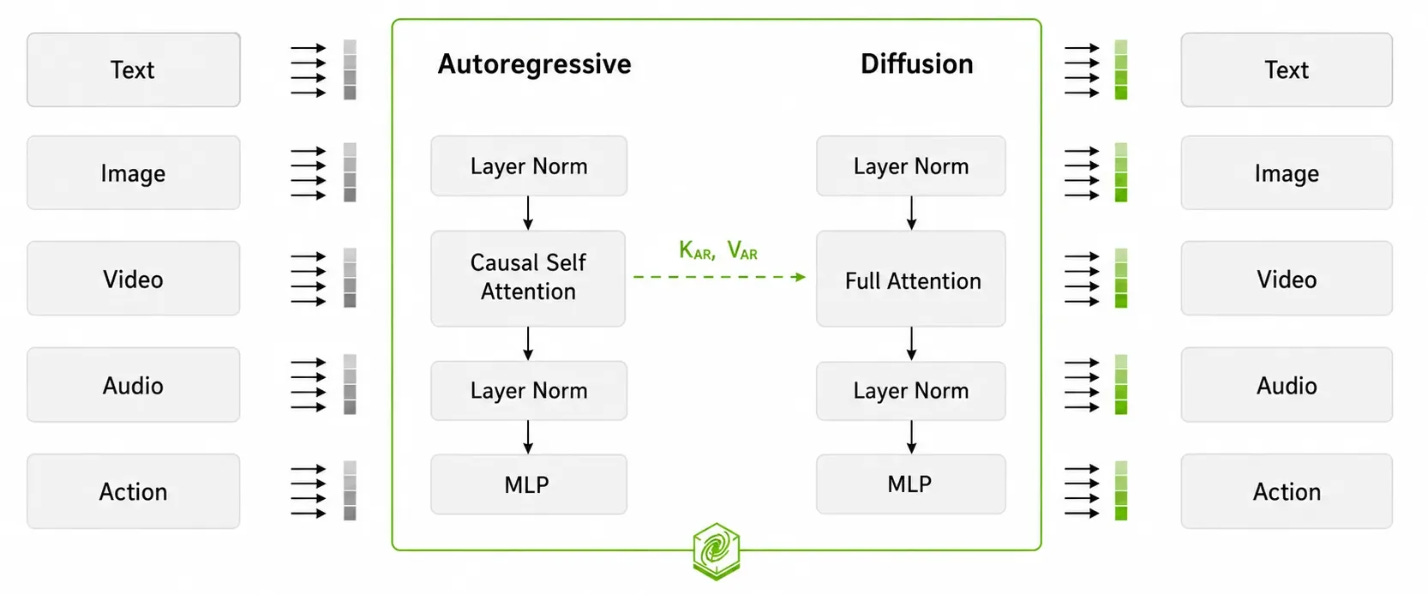
Cosmos 3 is NVIDIA’s first fully open omnimodel for Physical AI: a Mixture-of-Transformers design pairing an autoregressive reasoner (a VLM over text, image, video, audio, and action) with a diffusion-based generator that produces physics-aware video and action sequences conditioned on the reasoner. It takes any of those five modalities in and emits any of them out, so you can prompt with text plus a starting frame and get back predicted video alongside joint trajectories. Two variants are on HuggingFace now under OpenMDW 1.1 (Nano at 16B, Super at 64B; a 2B Edge model is promised), trained on 1.3B data points across 393 datasets and shipped with six open synthetic datasets spanning robotics, human motion, driving, and spatial reasoning. NVIDIA paired it with an open reference humanoid for academic labs: a Unitree H2 chassis with Sharpa tactile hands and a Jetson Thor, running the full Isaac stack, including Isaac Teleop for demonstration capture, with Ai2, ETH Zurich, Stanford, and UCSD already signed up. The open question is whether a single omnimodel can beat specialized stacks at world modeling and control simultaneously, or whether the bundled datasets are the more durable contribution.
Research
Qwen-VLA: one model for manipulation and navigation
The Qwen team extends its VLM stack to continuous action with Qwen-VLA, a DiT-decoder model jointly pretrained on robot trajectories, human egocentric video, sim data, and VLN. The numbers are strong (97.9% LIBERO, 86/87% RoboTwin), but the multi-source data recipe is what’s worth studying.
Wall-OSS-0.5 claims zero-shot manipulation from pretraining alone
X Square’s open 4B VLA Wall-OSS-0.5, pretrained across 20+ embodiments on more than 1M trajectories with gradient-bridged co-training, reports deployable zero-shot manipulation with no task fine-tuning at all. That claim is falsifiable with a download, which is exactly why it will get tested fast.
τ0-WM: a unified video-action world model on 27,300 hours
AGIBOT’s 5B τ0-WM trains policy and dynamics around one shared predictive representation instead of as separate objectives, on a documented mix of 17.8K hours of dual-arm teleop, 6.5K UMI-style, and 3K egocentric human video. One of the largest open embodied world-model releases so far, and the corpus accounting is unusually transparent.
ERVLA: embodied chain-of-thought doesn’t scale the way you’d hope
Built on the largest embodied-CoT corpus to date (979K trajectories, 2,592 hours), this Tsinghua paper finds that explicit CoT as an action prefix compounds inference errors, and gets better results using CoT as training-time representation supervision with reasoning-dropout. A negative result on a popular recipe, with data and checkpoints promised.
RoboDream: teleoperate without props, let the model fill in the scene
RoboDream synthesizes photorealistic demos by anchoring world-model generation to rendered robot motion while swapping objects, scenes, and viewpoints. The standout idea is prop-free teleoperation: the operator mimes the motion in empty air, and the model hallucinates the target objects afterward, which also eliminates reset time.
GEM: depth generation as a pretraining objective, plus a 4M-sample dataset
GEM adds a depth-map generation task directly into embodied VLM pretraining to inject the spatial grounding that text-only objectives miss, and releases GEM-4M alongside. The recipe transfers regardless of whether you use their action model.
Humanoid-GPT: 2B frames of motion data, zero-shot whole-body control
Humanoid-GPT is a GPT-style causal transformer pretrained on a 2B-frame retargeted corpus unifying the major mocap datasets. Scaling data and capacity together breaks the agility-versus-generalization trade-off that constrained shallow MLP trackers.
Claude as a robot teacher
A practitioner writeup on using an LLM to pick actions over world-model rollouts, logging its decisions as training data, then distilling into a small policy. Inference drops from 25 seconds to about 1 second per action on a real arm.
Quick hits
A cluster of VLA inference-efficiency papers landed this week: ElegantVLA (2605.29438) schedules per-step compute and doubles control frequency on GR00T, AURA (2606.02775) holds policy memory at 4KB regardless of episode length, DVAC (2606.03847) uses denoising variance to decide when to replan, and VisualThink-VLA (2605.30011) cuts reasoning latency 22.8x by replacing textual CoT with visual evidence tokens. Also worth a look: PointAction (2606.03943) uses predicted 3D pointmaps as an embodiment-agnostic action interface, and NVIDIA published a roundup of its eight sim-to-real papers at ICRA.
Worth Watching
ICRA 2026 wraps June 5 in Vienna. Award papers and talk recordings land next week, and NVIDIA’s sim-to-real roundup above is a reasonable preview of one thread to follow. The “From Data to Decisions: VLA Pipelines for Real Robots” workshop is the one we’ll be reading first.
Cosmos 3 Edge. NVIDIA promised a 2B variant for on-robot inference. If it ships with the same open license, it becomes the default baseline for edge world-model work.