

Gemini Robotics Released One Policy From Feet to Fingertips
Google DeepMind put a humanoid's legs, torso, arms and hands under a single learned policy this week, and ran one checkpoint across three different robots.
Gemini Robotics 2 controls the whole body
Figure got there first in one sense. Helix 02 replaced a hand-engineered balance controller with a learned one back in January, and drives locomotion and manipulation through one hierarchy on Figure’s own robots. What Gemini Robotics 2 adds is generality. Whole-body control now sits inside a general VLA, and DeepMind demonstrates it walking to a table, picking up a watering can, stepping to a shelf and placing it, as one continuous behavior rather than a handoff between modes. DeepMind scopes its own claim carefully, saying this is the first time their model can control entire humanoids.
The cross-embodiment result is the harder one. A single checkpoint controls Apptronik’s Apollo 2 with 22-DoF five-fingered SharpaWave hands, the same Apollo 2 with Inspire hands, and a Franka Duo with a Robotiq gripper. Two of those are dexterous humanoid hands with completely different kinematics, and the third is a parallel-jaw gripper on a fixed-base arm. Helix 02 runs on Figure’s fleet; this runs on whatever DeepMind pointed it at.
The release is three models. Gemini Robotics ER 2 does embodied reasoning over live video, tracks its own progress through a task, resumes from the last correctly completed step after a failure instead of restarting, calls tools including Search, and splits work across multiple robots of different types. Gemini Robotics 2 is the VLA. Gemini Robotics On-Device 2 runs locally and adapts to a new dual-arm embodiment from under 200 examples gathered in a few hours. A safety benchmark called ASIMOV-Agentic ships alongside, covering whether an embodied reasoner refuses unsafe tool calls from a VLA and whether it asks for human help when uncertain.
Read the access terms carefully, because most coverage has blurred them. ER 2 is public now through the Gemini API and AI Studio. Gemini Robotics 2 and On-Device 2 are limited to selected early-access partners. DeepMind’s own results chart is also candid that multi-finger dexterous manipulation lags well behind whole-body and gripper tasks, so the 22-DoF hands are the demo and the grippers are the working system.
Research
Alpamayo 2 Super is 34B of open weights you can ship
NVIDIA released Alpamayo 2 Super, a 32B vision-language backbone built on Cosmos 3 Super Reasoner paired with a 2.3B diffusion action expert, with weights under OpenMDW-1.1 and code under Apache-2.0, cleared for commercial use. It handles trajectory prediction, visual question answering, 2D grounding and auto-labeling from multi-camera video plus egomotion history, and NVIDIA reports it first on LingoQA among roughly 40 models, ahead of Qwen2.5-VL 72B by 17.0 points on Lingo-Judge. Auto-labeling is the capability worth noting, since it makes the model something you can point at your own fleet video rather than only a driving policy.
TurboVLA drops the language model from the middle
The standard VLA pathway projects visual observations into an LLM’s representation space before decoding actions, and pays for that on every policy call. TurboVLA, from HUST and Huawei, encodes vision and language independently, exchanges information between them through a lightweight bidirectional interaction, and predicts continuous action chunks with a compact decoder. At 0.2B parameters it reports 97.7% average success on LIBERO with 31.2ms latency and 0.9GB of inference VRAM on a consumer RTX 4090, and the code is up. LIBERO is a sim benchmark and a single setup, so treat it as a lead worth checking rather than a settled result, but it is cheap enough that anyone with a gaming GPU can check it.
Frontier VLMs given a body score 16.8%
HumanCLAW separates deciding from executing, putting a vision-language model in command of a physically simulated body across 1,218 episodes. Nine state-of-the-art models were evaluated and the best reached 16.8%. The diagnosis is more useful than the number. These models lose track of their own body, and cannot reliably report where it is, whether it has reached the goal, or whether it has hit an obstacle.
GAIA-4 puts radar in the simulation loop
Wayve’s GAIA-4 closes the loop that GAIA-3 left open. The AI Driver goes back in and its decisions condition what it perceives next, so braking slows the generated viewpoint and steering shifts the next scene, while every other agent replays its logged trajectory exactly and the scene stays anchored to the real recording as a deterministic baseline. The technical claim is joint generation of radar alongside camera, which Wayve calls an industry first for driving simulators, and they show generated radar measurably changing the closed-loop trajectory in a case where the vehicle failed to slow. Their argument generalizes past driving. A simulator that only renders cameras cannot validate a system that consumes camera plus radar, and the same holds for tactile or audio in manipulation. No weights, no API, and no parameter count disclosed.
NVIDIA argues world-action models make data cheaper, with an ablation
A VLM backbone learns to describe a scene rather than predict how it evolves, which is the case NVIDIA makes for building policies on video world models instead. One part of it comes with evidence. Two DROID policies trained on identical recipe, data and compute, differing only in whether they started from an omni checkpoint pretrained on multi-domain action data, moved RoboLab success from 28.1% to 36.8%. They released Cosmos3-Nano-Policy-DROID at 16B and a 4B edge variant, both marked for commercial use. The broader assertion, that varied data wasted on a VLA becomes training signal for a world action model, is a vendor thesis and the ablation only tests one slice of it.
ACE-Data-0 records a home from eight angles at once
ACE turns real homes into calibrated capture rigs at two scales, table-scale for hand-object manipulation and room-scale for whole-body motion and locomotion, recording egocentric video, 8+ exocentric views, full-body and articulated hand motion, per-object mesh geometry with 6-DoF trajectories, multi-channel audio and tactile as one synchronized stream. ACE-Data-0 is 150 hours, 17M frames, 200 task categories, 50 participants and 75,000 interaction episodes, and participants work from goal-level instructions rather than scripts so hesitation and improvisation survive. Most annotations are derived from tracked physical state rather than estimated by off-the-shelf pipelines. The paper says it releases the dataset; the Hugging Face card says data files are not published yet and gates access behind a non-commercial research license.
How much proprioceptive history a VLA should get
Most teams pick a state interface by taste and never revisit it. This ablation tests five interface designs with state history swept from 1 to 96 frames across 45 atomic and 20 composite tasks, answering whether current state helps, how far back history pays, and where in the model state should enter. It reads well next to HumanCLAW, one paper finding that models lose track of their bodies and the other measuring how to tell them.
PhiZero reasons in a discrete physical language before rendering
Video world models predict future pixels, which leaves the dynamics buried inside a high-dimensional visual predictor. PhiZero, from CASIA, learns a compact discrete representation of world-state transitions from in-the-wild video by self-supervision, then infers the future as a sequence in that representation and renders it into video afterward. It supports action-conditioned simulation and zero-shot motion transfer, and it drew more attention on Hugging Face than any other robotics-adjacent paper this week.
WorldExam separates pretty video from a world that reacts
WorldExam scores controllable video generators across four tiers, visual quality, control adherence, spatial consistency and world reactivity, over 1,474 test cases in eight tasks. Reactivity is the tier that matters and the results split cleanly across 20 models: camera-driven models control the camera well and support no dynamic interaction, action-driven models give precise subject control with limited world response, and language-driven models interact better but break on complex instructions.
LeRobot v0.6.1
v0.6.1 is the consolidation release after July’s expansion. Datasets gain slice support, streaming from HF storage buckets and token auth for private repos; policies now share VLA components across π0, π0.5, EO-1 and others, and Wall-X subclasses native Transformers Qwen2.5-VL instead of vendoring it. One breaking change to watch, lerobot.types is now lerobot.lerobot_types.
Quick hits
MiniWorld — a block-causal video DiT with flow matching that trains a streaming world model in several days on a single 8-GPU server, with code and checkpoints out, which makes this thread reproducible on one node.
Quo Vadis, World Modeling? — twenty authors argue world models should be organized around six agent-facing proxies covering dynamics, space, execution, memory, skill and reward, useful mostly as a map when four items in one issue all claim the same label.
Bimanual Manipulation Within an 8 GB Budget — zero-copy sensing and quantized ACT on an entry-level Jetson, the other end of the same thread TurboVLA is on.
Track4Action — distills a world-centric 3D tracker into VLA policies rather than leaving spatial tracking implicit in the backbone.
Industry
AMD makes a full-stack play for robot compute
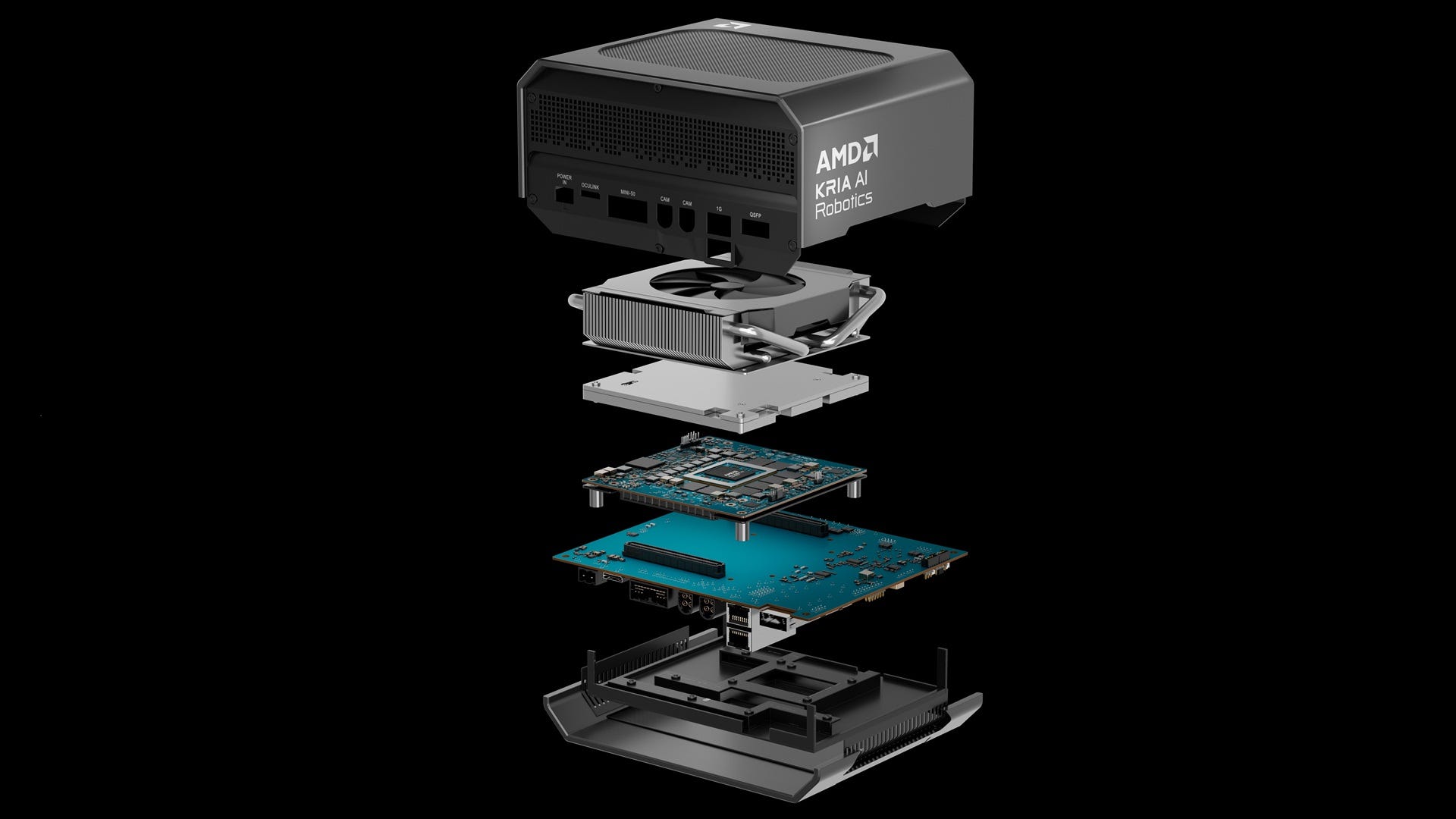
AMD used Advancing AI to launch the Ryzen AI Embedded X100 and the Kria AI SOM, up to 16 Zen 5 cores with an integrated GPU and an NPU, sharing unified memory specifically to cut data copies between perception, fusion and planning. Two decisions matter more than the silicon. The module uses the open COM-HPC standard rather than a proprietary form factor, so other vendors can build compatible hardware, and the software story is ROCm with ROS 2, Nav2, PyTorch and ONNX, with AMD claiming roughly 75% CUDA code preservation on migration. Against Jetson Thor T5000 they claim 3.4x better real-time reliability, 1.6x more free CPU cores and 2.3x more concurrent agents, though every published number is AMD-commissioned and was run on a mini PC standing in for the target part, not on a robot. Foundation Robotics is named as an early customer migrating off Intel and NVIDIA. Modules ship from ODM partners in Q4 and the dev platform reaches general availability in Q4, at a price trade coverage expects above $5,000. AMD has not published one.
Where the money went
Five rounds worth noting, and three of them fund data collection rather than model training. PokeBot closed over $100M roughly 120 days after incorporation, having made manipulation its primary research target rather than something a locomotion platform picks up later, and built its own data-collection hardware for fine manipulation to feed the training loop. PaXini raised RMB 1B for tactile sensing chips having shipped close to a million units in the past year, which is the supply side of last week’s tactile story. Enigma left stealth with a $71M seed and put 100 real robots online for anyone to drive at robots.online, explicitly to learn how people approach robots and feed that back. Ant Group’s Robbyant began raising about $222M externally, and Avatar Robotics raised a $6.5M seed on the back of 900,000 products handled since December with human operators generating the autonomy data.
Worth Watching
NVIDIA is running a Cosmos Labs livestream on August 13, announced at the end of the world-action-model post, which is the likely venue for the next policy drop.
The first independent benchmarks of AMD’s X100 against Jetson Thor will decide whether this is a second source or a press release. Q4 pricing matters too, against Jetson module increases of up to 101% last month.
CoRL and IROS 2026 project pages are landing. IROS is in Pittsburgh, September 27 to October 1.