

LeRobot v0.6.0 Adds World Models, Reward Models, and an Open GR00T
Weekly Physical AI Roundup.
The open-robotics stack had a big week. LeRobot v0.6.0 pulled world-model policies, reward models, an eval-and-rollout loop, and a frontier open VLA into the framework most robot-learning work already uses.
LeRobot v0.6.0 closes the learning loop
LeRobot v0.6.0 is built around closing the learning loop. It adds three world-model policies that imagine the future (VLA-JEPA, LingBot-VA, FastWAM), a reward-models API (Robometer, TOPReward), a lerobot-rollout CLI with DAgger-style human-in-the-loop corrections that turn failures into training data, and six simulation benchmarks unified under lerobot-eval. The marquee model is NVIDIA’s GR00T N1.7, a 3B open reasoning VLA released in April and trained on roughly 20,000 hours of human egocentric video under what NVIDIA calls a dexterity scaling law. It’s now the default VLA in LeRobot in place of N1.5 and ships with Isaac Teleop for data collection, reporting around 88% average on LIBERO in a preliminary integration, though running it needs an NVIDIA GPU and access to its gated Cosmos-Reason2 backbone. VLA-JEPA is the one to look at, training a JEPA world model to predict future frames from the policy’s own actions and then dropping it at inference for zero added cost, with DROID-pretrained checkpoints on the Hub. Datasets also gain depth support, automatic VLM language annotation, and up to 2x faster loading.

Research
Robbyant open-sources a 60,000-hour VLA
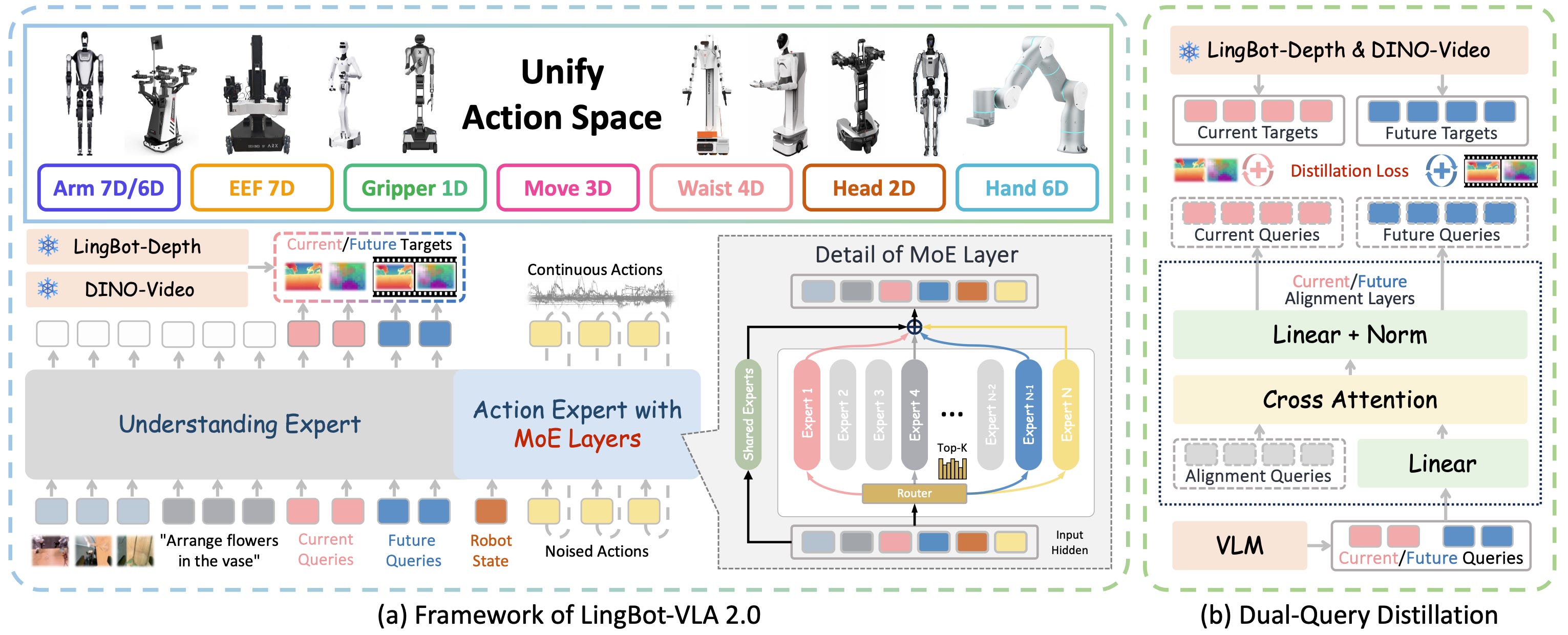
Ant Group’s Robbyant open-sourced LingBot-VLA 2.0, pre-trained on what the company describes as 60,000 hours of physical data, 50,000 hours of cleaned real-robot interaction plus 10,000 hours of distilled first-person human video, across 20 robot morphologies from 17 makers. On SJTU’s GM-100 dual-arm benchmark the company reports it ahead of π0.5 and GR00T N1.7, so treat that ranking as a single-benchmark vendor claim; the reusable part is the data recipe, a 5-to-1 blend of real-robot and human-video hours. A companion 1B vision model, LingBot-Vision, was opened alongside it.
Mistral’s first robotics model navigates from a single camera
Robostral Navigate is an 8B navigation model that takes an RGB image and a plain-language instruction and moves a robot to the target, predicting where to go by pointing at image coordinates rather than metric displacements, which keeps it robust to camera and scale changes. Trained entirely in simulation and running on wheeled, legged, and flying robots, Mistral reports 76.6% on R2R-CE validation-unseen from a single camera, above depth and multi-camera systems, though it’s a vendor number on one benchmark with no weights or paper released. It’s also Mistral’s first robotics model, part of a physical-AI push that followed its Emmi AI acquisition.
GigaWorld-1 asks what makes a world model a trustworthy evaluator
Evaluating robot policies means slow, costly real rollouts, which is why people want world models to stand in as evaluators. GigaWorld-1, from GigaAI and Tsinghua, builds WMBench from real teleop paired with matched policy rollouts and studies 7 video world models across 324,000+ simulated rollouts. Its main finding is that evaluator quality tracks long-horizon, action-faithful rollout consistency rather than short-term visual realism, which cuts against the instinct to chase sharper generated video.
Deform360 puts 2D and 3D world models head-to-head on deformables
Deform360 (Brown, Columbia, MIT) is a real-world dataset for deformable-object dynamics: 198 everyday objects, 1,980 interaction sequences, 215+ hours from 41 surround cameras and bimanual tactile grippers, with a markerless visuotactile tracking pipeline for dense geometry and motion. The authors use it to compare 2D video world models against 3D particle models on the same deformable interactions, which is a controlled read on a case both paradigms struggle with.
InternVLA-A1.5 gets world-model dynamics into a VLA without generating pixels
InternVLA-A1.5, from Shanghai AI Lab, keeps a VLM backbone training on VQA and subtask prediction and adds learnable foresight tokens that condense the task-relevant future into a compact latent, supervised by a frozen video generator. The video branch is dropped at inference, so the policy inherits dynamics priors while staying real-time. Pretrained on 1.2M robot episodes plus 3M multimodal samples, it reports the best overall results across six simulation benchmarks.
Does a VLA’s reasoning reflect what it actually does?
This paper from Stanford and NVIDIA Research separates functional reasoning, where a chain of thought improves performance, from faithful reasoning, where it reflects the policy’s real decision process, and shows the two come apart. A human study on a state-of-the-art driving reasoner finds reasoning quality and trajectory improvement only loosely coupled; the authors then train a critic, Pinocchio, that scores observation grounding and step coherence and use it as a dense RL reward, improving faithfulness 4 to 18% while holding task performance. Worth reading next to last week’s work on what VLAs retain from their base VLMs.
TAP separates learning to move from learning what to do
TAP (Fudan) argues VLA training conflates physical competence with semantic grounding, and only the latter needs language labels. It first learns motor priors from cheap unlabeled interaction, including discarded off-task trajectories and robot play, through a self-supervised inverse-dynamics objective, then grounds them with minimal expert data. On SIMPLER it matches models trained on over a million expert trajectories using orders of magnitude fewer labels, and holds 25% success under camera perturbations where internet-scale baselines collapse.
Freeform Preference Learning turns quality into named axes
Freeform Preference Learning, from Chelsea Finn’s group at Stanford, lets annotators define natural-language preference axes such as speed, safety, or placement quality and give pairwise preferences along each, then learns a language-conditioned reward and a policy that optimizes across them. Across four real and two simulated long-horizon tasks it reports a 38-point gain over sparse-reward and binary-preference baselines, and learns dense progress signals without hand-labeled subtasks.
Quick hits
SIEVE — selects imitation data by reusable motor primitives rather than whole trajectories, matching full-data VLA training on half the demonstrations and half the training steps, with code released.
PRISM — generates a personalized training set for a target environment from a single image and one instruction, no teleoperation, and reports up to 100% success on three real tasks.
ASPIRE — NVIDIA GEAR’s continual-learning agent writes and refines its own code-as-policy programs and banks a reusable skill library across sim, real, and embodiments; paper is out, code pending.
RoboDojo — a unified sim-and-real benchmark of 42 simulated and 18 real tasks spanning generalization, memory, precision, and long-horizon skills, from a large multi-lab group.
Can VLAs be verified to reason physically? — a position paper arguing reported VLA gains may reflect semantic matching rather than physical generalization, a useful counterweight to the faithfulness work above.
Industry
The LeRobot founders start a humanoid company
UMA is the Paris startup from Rémi Cadène, who led Hugging Face’s LeRobot, its co-founder Simon Alibert, and Robert Knight, who designed the SO-100 and SO-101 open-source arms, with ex-DeepMind’s Pierre Sermanet as chief scientist. This week they revealed a humanoid design, Northstar, and a learn-from-demonstration system they call Real-Time Learning, aimed at European manufacturing. Nothing technical is out yet, but for anyone building on LeRobot or those arms it’s worth knowing that the people who made them are now running a commercial humanoid company, the same week Hugging Face shipped LeRobot v0.6.0.
Worth Watching
RSS 2026 (Sydney, July 13-17) project pages and camera-readies start landing over the next couple of weeks.
Code and weights for this week’s data and world-model papers are still pending: Deform360, GigaWorld-1’s WMBench, and PRISM.
With GR00T N1.7 and LingBot-VLA 2.0 both open, watch for community fine-tunes and third-party benchmark runs that test the vendor numbers on independent setups.